Counter-Currents
  • Advertise
  • Private Events
  • T&C
  • About
  • Contact
  • RSS
    • Main feed
    • Podcast feed
    • Videos feed
    • Comments feed
  • Welcome
  • Webzine
  • Books
  • Merch
  • Podcasts
  • Videos
  • Donate
  • Patrons
  • Subscribe
  • Crypto

LEVEL2

Donate Now Mailing list

Writer of June

(4 votes) David M. Zsutty

Article of June

Why White Advocates Should Avoid “Based Blacks” by Dani Vypont 4 votes
  • Welcome
  • Webzine
  • Books
  • Merch
  • Podcasts
  • Videos
  • Donate
  • Patrons
  • Subscribe
  • Crypto
    • Replacement Migration & Hypergamy

      F. Roger Devlin

      22

    • Kurds of a Feather Flock Together:
      Europe’s “Racist” Parakeet Tweet-Storm

      Steven Tucker

      1

    • Elevator Pitch to a Billionaire
      Money, Money, Money

      Ondrej Mann

      1

    • All Hail Rhodesia

      Spencer J. Quinn

      3

    • Nationalism This Week
      Disenfranchisement

      Greg Johnson

      29

    • The Murder of Ann Widdecombe

      Lipton Matthews

      9

    • Disclosure Day
      Please, Keep It Undisclosed

      Francisco Albanese

      11

    • Remembering Carl Schmitt
      July 11, 1888–April 7, 1985

      Greg Johnson

      1

    • Editor’s Update
      Fundraiser Update & New Books

      Greg Johnson

      1

    • Third Homeland Institute Poll on the Great Replacement

      David M. Zsutty

      12

    • The Bitter End of Western Metaphysics:
      Heidegger on Nietzsche, Part Five (Conclusion)

      Collin Cleary

      9

    • Fraudulent Black British History

      Mark Gullick

      7

    • A White Nationalist Response to Scott Greer

      Dave Chambers

      25

    • The Miami Mall Incident:
      Black Youths or Black Extraterrestrials?

      Dominic Fox

      6

    • The Theology of Three Populisms

      Morris van de Camp

      2

    • The Dangers of Skilled Immigration

      Lipton Matthews

      25

    • The Brotherhood of the Bell

      Beau Albrecht

      16

    • Endeavor: What Rome Means to Me

      Endeavour

    • When the Family Becomes Predation

      Jayant Bhandari

      5

    • RICU: The Gentle Art of Persuasion

      Mark Gullick

      7

    • Mind of Darkness:
      A Review of Lipton Matthews’s Busting African Delusions

      Derek Stark

      12

    • Remembering Revilo Oliver
      July 7, 1908–August 20, 1994

      Greg Johnson

      2

    • Some Advantages of Irish Nationalism

      Greg Johnson

      30

    • America at 250 from the National Cathedral

      Gabriel Anderson

      18

    • Why Not Stop All the Clocks?
      Modern Conservatism’s Flagging Commitment Towards Turning Back Time

      Steven Tucker

      3

    • Remembering Jean Raspail
      July 5, 1925–June 13, 2020

      Greg Johnson

      2

    • Editor’s Update
      Fundraiser Update & New Books

      Greg Johnson

    • The Ethnic Reality of FIFA 2026

      Samuel Valleus

      13

    • Nationalism This Week
      Tucker’s New Party

      Greg Johnson

      30

    • Ethiopia Against Italy
      How the Italo-Ethiopian Wars were part of the conflict between Eastern & Western Christiandom

      Morris van de Camp

    • Please Vote in Our Writer & Article of the Month Poll

      Greg Johnson

    • Available for Pre-Order!
      F. Roger Devlin’s Not Hooking Up

      F. Roger Devlin

    • Kolberg: The Last Nazi (or Prussian?) Film

      Steven Clark

      2

    • America 250 & The Fate of Empires

      Richard Houck

      20

    • Available for Pre-Order!
      Greg Johnson’s The Battle of the Books

      Greg Johnson

    • Why All the Silence About Blacks Being Kicked Out of South Africa?
      Because It’s Other Blacks That Are Doing It.

      Steven Tucker

      10

    • Zelensky, the Jewish Conspiracy Narrative, & the Demographic Replacement of Ukraine:
      A Critical Analysis of a Disinformation Discourse within the European Identitarian Right

      Luís Graça

      30

    • The Original Congressional Debate on Birthright Citizenship

      Alex Graham

      13

    • America at 250
      Unmanifested Destiny  

      David M. Zsutty

      32

    • The Normies are Waking Up:
      The Alliance for Responsible Citizenship Conference, London 2026

      Lipton Matthews

      2

    • Ethnic Vigilantism: The Movie

      Mark Gullick

      15

    • Lothrop Stoddard’s The Revolt against Civilization

      Kevin MacDonald

      2

    • David Zsutty on Political Organizing

      David M. Zsutty

    • PC-Incompatible Gaming:
      Plantation Simulator and the “Problem” of Racist Video Games

      Steven Tucker

      3

    • Remembering Lothrop Stoddard
      June 29, 1883–May 1, 1950

      Greg Johnson

      1

    • Editor’s Update
      Fundraiser Update & Upcoming Projects

      Greg Johnson

    • Nationalism This Week
      Metapolitics Wins:
      Scott Greer’s Whitepill

      Greg Johnson

      8

    • Remembering Colin Wilson
      June 26, 1931–December 5, 2013

      Greg Johnson

      3

    • Kevin Deanna on Political Organizing

      Kevin Deanna

      1

    • The Bitter End of Western Metaphysics:
      Heidegger on Nietzsche, Part Four

      Collin Cleary

      6

    • Connor McDowell

      Replacement Migration and Hypergamy

      I’ve seen this OKCupid miscegenation argument before, and while much of my evidence is anecdotal, I...

    • Dominic Fox

      Disenfranchisement

      Even a real community will consist mostly of people who are only somewhat similar in character/...

    • Dani Vypont

      Replacement Migration and Hypergamy

      @JamesSunderland With regard to one of your earlier posts, I did some research, and it is ...

    • Dani Vypont

      Replacement Migration and Hypergamy

      What parts of the United States would you say have the most and least interracial relationships?It...

    • Dave Chambers

      All Hail Rhodesia

      Rhodesia is an inspiration to all of us whose families have had to flee the neighborhoods and...

    • CC reader

      Disclosure Day

      Duel was a very good movie, and it was made for tv. Good suspense, camera work, musical score, and...

    • WU

      Replacement Migration and Hypergamy

      I visited Norway 3 years ago, and the experience was so strange it is worth relating. In Bergen,...

    • Dave Chambers

      Replacement Migration and Hypergamy

      What parts of the United States would you say have the most and least interracial relationships?

    • CC reader

      Third Homeland Institute Poll on the Great Replacement

      If a white ethnostate is carved out, the 67% who voted against returning to 60% white or higher...

    • Zarathustra

      Replacement Migration and Hypergamy

      MTV and Hollywood are partly to blame for this.

    • Dani Vypont

      Replacement Migration and Hypergamy

      I once had a Norwegian nationalist ask me to tell him the degree of mixing between White women &...

    • James Sunderland

      Replacement Migration and Hypergamy

      With regard to one of your earlier posts, I did some research, and it is possible to determine the...

    • Glide Ratio 0:1

      Replacement Migration and Hypergamy

      Maybe the NSDAP were correct about Persians (you could be Arab?) being Aryan. You seem to suffer...

    • Fionn McCool

      Replacement Migration and Hypergamy

      Dani, for what it’s worth, your 92% figure refers to biracial children born to black fathers and...

    • Dani Vypont

      Replacement Migration and Hypergamy

      Both of those sources rely on marriage data. The first one is titled "Intermarriage in America Post-...

    • Fionn McCool

      Replacement Migration and Hypergamy

      Most people are the most attracted to individuals of their own race. Regardless, the broader...

    • James Sunderland

      Replacement Migration and Hypergamy

      Here is analysis conducted using U.S. Census Data. You can't get better than this: https://www....

    • Hairy Iranian Dude

      Replacement Migration and Hypergamy

      I love Norway. It’s a real country (used to be?). I was there for six days in 2018: Oslo and Bergen...

    • Dani Vypont

      Replacement Migration and Hypergamy

      In the U.S., white woman have the lowest rate of miscegenation across all intersections of race and...

    • Glide Ratio 0:1

      Replacement Migration and Hypergamy

      This is one hundred percent my observations moving from England to the USA. White American females...

    • Earth Day Special

      John Morgan

      12

    • A Robertson Roundup
      Remembering Wilmot Robertson
      (April 16, 1915 – July 8, 2005)

      Margot Metroland

      13

    • The Paranoid Style in White Nationalism

      Greg Johnson

      30

    • Join the Dance!

      Andrew Hamilton

      1

    • We Can’t Save the Earth Without Reducing African Birth Rates

      James Dunphy

      36

    • “I’m Not a Conspiracy Theorist, but . . .”:
      Jeffrey Epstein’s Death Gives New Life to “Conspiracy Theories”

      Greg Johnson

      22

    • Sylvia Plath: Stasis in Darkness

      Vic Olvir

      17

    • Vanguardism, Vantardism, & Mainstreaming

      Greg Johnson

      80

    • Aviation, Geography, & Race

      Charles Lindbergh

      3

    • Some Thoughts on Yule

      Collin Cleary

      4

    • Living in Truth:
      A Yuletide Homily

      Jef Costello

      7

    • John Kennedy Toole’s A Confederacy of Dunces

      Greg Johnson

      20

    • On Aleksandr Solzhenitsyn’s Warning to the West

      Spencer J. Quinn

      7

    • Elitism, British Modernism, & Wyndham Lewis

      Jonathan Bowden

      6

    • Philip K. Dick’s Do Androids Dream of Electric Sheep? as Anti-Semitic/Christian-Gnostic Allegory

      Greg Johnson

      20

    • “Conspiracy Theory” or Conspiracy?

      Andrew Hamilton

      21

    • Remembering H. P. Lovecraft
      (August 20, 1890–March 15, 1937)

      Greg Johnson

      3

    • Who Are We?
      Nordics, Aryans, & Whites

      Greg Johnson

      71

    • Remembering William Gayley Simpson
      (July 23, 1892–December 31, 1990)
      A Pleasant Afternoon with Harriet & Bill Simpson

      Margot Metroland

      18

    • Here are the Young Men
      Remembering Ian Curtis
      (July 15, 1956–May 18, 1980)

      Mark Gullick

      18

    • Percy Grainger
      Artist of the Right

      Alex Graham

      7

    • Remembering Revilo Oliver
      (July 7, 1908–August 20, 1994)

      Greg Johnson

      18

    • The Meaning of July 4th for the White Man

      Gregory Hood

      13

    • The Front National’s Evolution

      Bruno Mégret

    • Merwin K. Hart
      Forgotten American Hero & Man of the Right

      Morris van de Camp

      10

    • George Orwell’s Nineteen Eighty-Four

      Jonathan Bowden

      8

    • Carleton S. Coon
      Scientist & Reluctant White Advocate

      Morris van de Camp

      4

    • The Kwanzaa Absurdity Will Be Dwarfed by Juneteenth

      Robert Hampton

      12

    • Stravinsky

      Alex Graham

      7

    • Like the Roman:
      Remembering Enoch Powell (1912-1998)

      Mark Gullick

      23

    • Exclusive Interview with Karel Veliky:
      The Final Chapter in the Film Series! Part II

      Ondrej Mann

      2

    • Exclusive Interview with Karel Veliky:
      The Final Chapter in the Film Series! Part I

      Ondrej Mann

      2

    • Nietzsche & Race

      Mark Gullick

    • The Crisis of Chinese Technology Thieves

      Morris van de Camp

      1

    • The Zodiac Killer

      Mark Gullick

      12

    • José Pedro Zúquete’s The Identitarians

      Greg Johnson

      3

    • Berlin: City of Stones

      Spencer J. Quinn

      6

    • Headbanging Lite

      Mark Gullick

      5

    • The Russians are Coming/The Russians are Coming

      Steven Clark

      2

    • The Cruelty of Kindness

      Morris van de Camp

      11

    • Jonathan Bowden’s Deliverance
      Part 7

      Jonathan Bowden

    • Lothrop Stoddard’s The Revolt Against Civilization

      Spencer J. Quinn

      15

    • About Film “From the Right”

      Karel Veliky

    • The 1970s: The Golden Age of Hijacking

      Morris van de Camp

      21

    • Jonathan Bowden’s Deliverance
      Part 6

      Jonathan Bowden

    • Do You Want to Play a Game?

      Mark Gullick

      1

    • Sexually Incontinent on the Indian Subcontinent:
      Who Rapes More Animals, Indians or Pakistanis? The Battle Continues!

      Steven Tucker

      3

    • Neo-Fascism in Film
      Part 5

      Karel Veliky

      15

    • The Game of Tarot

      Mark Gullick

      2

    • Institutions Cannot Be Transplanted

      Jayant Bhandari

      5

    • Jonathan Bowden’s Deliverance
      Part 5

      Jonathan Bowden

    • Crosstown Traffic:
      Jimi Hendrix & The Post-War Rock ‘N’ Roll Revolution

      Mark Gullick

      1

    • Slaves from the North:
      Finns & Karelians in the East European Slave Trade, 900–1600

      Lipton Matthews

      14

    • Neo-Fascism in Film
      Part 4

      Karel Veliky

      2

    • David Lean’s A Passage to India

      Spencer J. Quinn

      1

    • Elites are Essential to Development

      Lipton Matthews

      7

    • Jonathan Bowden’s Deliverance
      Part 4

      Jonathan Bowden

    • Neo-Fascism in Film
      Part 3

      Karel Veliky

      6

    • E. M. Forster’s A Passage to India & the Indian Mentality

      Spencer J. Quinn

      25

    • Jonathan Bowden’s Deliverance
      Part 3

      Jonathan Bowden

    • András László
    • Derek Hawthorne
    • Beau Albrecht
    • Alain de Benoist
    • Kerry Bolton
    • Jonathan Bowden
    • Collin Cleary
    • Jef Costello
    • Savitri Devi
    • Julius Evola
    • Jim Goad
    • Gregory Hood
    • Juleigh Howard-Hobson
    • Greg Johnson
    • Charles Krafft
    • Anthony M. Ludovici
    • Trevor Lynch
    • H. L. Mencken
    • J. A. Nicholl
    • James J. O’Meara
    • Christopher Pankhurst
    • Tito Perdue
    • Michael Polignano
    • Spencer J. Quinn
    • Fenek Solère
    • Irmin Vinson
    • Leo Yankevich
    • Francis Parker Yockey
    • Multiple authors
  • Editor-in-Chief

    • Greg Johnson, Ph.D.

    Featured Writers

    • Beau Albrecht
    • Gunnar Alfredsson
    • Collin Cleary, Ph.D.
    • Jef Costello
    • Morris V. de Camp
    • F. Roger Devlin, Ph.D.
    • Stephen Paul Foster, Ph.D.
    • Jim Goad
    • Alex Graham
    • Mark Gullick, Ph.D.
    • Greg Johnson, Ph.D.
    • Travis LeBlanc
    • Trevor Lynch
    • Margot Metroland
    • James J. O’Meara
    • Angelo Plume
    • Spencer J. Quinn
    • Fred Reed
    • Clarissa Schnabel
    • Michael Walker
    • David M. Zsutty

    Frequent Writers

    • Asier Abadroa
    • Aquilonius
    • Alain de Benoist
    • Kerry Bolton, Ph.D.
    • Dave Chambers
    • Steven Clark
    • James Dunphy
    • Endeavour
    • Richard Houck
    • Jason Kessler
    • Titus Livius
    • Ondrej Mann
    • Lipton Matthews
    • Mark Mazari
    • John Morgan
    • Jaroslav Ostrogniew
    • Kathryn S.
    • Christian Secor
    • Anne Wilson Smith
    • Thomas Steuben
    • William De Vere
    • Kenneth Vinther
    • Max West

    Classic Authors

    • Maurice Bardèche
    • Jonathan Bowden
    • Julius Evola
    • Guillaume Faye
    • Ernst Jünger
    • Kevin MacDonald, Ph.D.
    • D. H. Lawrence
    • Charles Lindbergh
    • Jack London
    • H. P. Lovecraft
    • Anthony M. Ludovici
    • Sir Oswald Mosley
    • National Vanguard
    • Friedrich Nietzsche
    • Revilo Oliver
    • William Pierce
    • Ezra Pound
    • Saint-Loup
    • Savitri Devi
    • Carl Schmitt
    • Miguel Serrano
    • Oswald Spengler
    • P. R. Stephensen
    • Jean Thiriart
    • John Tyndall
    • Dominique Venner
    • Leo Yankevich
    • Francis Parker Yockey

    Other Authors

    • Howe Abbott-Hiss
    • Michael Bell
    • Giles Corey
    • Jack Donovan
    • Richardo Duchesne, Ph.D.
    • Emile Durand
    • Guillaume Durocher
    • Mark Dyal
    • Tom Goodroch
    • Andrew Hamilton
    • Robert Hampton
    • Huntley Haverstock
    • Derek Hawthorne
    • Gregory Hood
    • Juleigh Howard-Hobson
    • Alexander Jacob
    • Ruuben Kaalep
    • Tobias Langdon
    • Julian Langness
    • Patrick Le Brun
    • G A Malvicini
    • John Michael McCloughlin
    • Millennial Woes
    • Michael O’Meara
    • Christopher Pankhurst
    • Michael Polignano
    • J. J. Przybylski
    • Quintilian
    • Edouard Rix
    • C. B. Robertson
    • C. F. Robinson
    • Herve Ryssen
    • Alan Smithee
    • Fenek Solere
    • Ann Sterzinger
    • Robert Steuckers
    • Tomislav Sunic
    • Donald Thoresen
    • Marian Van Court
    • Irmin Vinson
    • Book Reviews
    • Movie Reviews
    • TV Reviews
    • Music Reviews
    • Art Criticism
    • Graphic Novels & Comics
    • Video Game Reviews
    • Fiction
    • Poems
    • Interviews
    • Videos
    • English Translations
    • Other Languages
      • Arabic
      • Bulgarian
      • Croatian
      • Czech
      • Danish
      • Dutch
      • Estonian
      • Finnish
      • French
      • German
      • Greek
      • Hungarian
      • Italian
      • Lithuanian
      • Norwegian
      • Polish
      • Portuguese
      • Romanian
      • Russian
      • Slovak
      • Spanish
      • Swedish
      • Ukrainian
    • Commemorations
    • Why We Write
  • Archives
  • Top 100 Commenters
  • The Looney Bin
  • Advertise
  • Private Events
  • T&C
  • About
  • Contact
  • RSS
    • Main feed
    • Podcast feed
    • Videos feed
    • Comments feed
Sponsored Links
Europa.com Above Time Coffee Antelope Hill Publishing Paul Waggener IHR-Store Spencer J. Quinn American Renaissance Jim Goad The Occidental Observer
Print May 8, 2020 8 comments

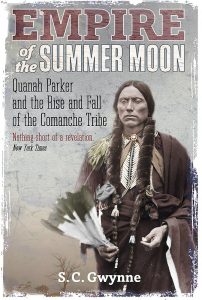
S. C. Gwynne’s Empire of the Summer Moon

Spencer J. Quinn

3,288 words

S.C. Gwynne’s magnificent Empire of the Summer Moon hits as hard as literature can hit and offers history as a form of sublime entertainment. I believe the author wouldn’t take all the credit for his book’s success, since the subject matter — which is, as the subtitle tells us, the rise and fall of the nineteenth-century Comanche nation — is so fascinating, so packed with action, so rife with contradictions, so laden with heart-wrenching drama, and so existential in its meaning, the story pretty much writes itself.

Gwynne, however, deserves credit for leaving us hanging about how we should size up the Comanche today. This opens doors for various race-realist and ethnocentric interpretations of the Comanche and their savage wars against not just the whites, but against all their enemies. And if you weren’t a Comanche, you were most likely considered an enemy. As mysterious and perplexing as they were to the Texas Panhandle pioneers, as well as to the Mexicans and the Spanish conquistadors before them, the Comanche remain so today thanks in part to Empire of the Summer Moon.

What struck me most about Gwynne’s approach was how he exchanged a dignified academic pretense for a kind of campfire confidence which lends Empire of the Summer Moon the unsettling feel of a ghost story, only real. Real as dust and bones today, but much more real a century and a half ago when pioneers and ranchers in the disorganized and extremely penurious new nation of Texas had to contend with a ruthless and highly-competent stone-aged people upon whose land they were encroaching. You think you know what terror is? You do not know what terror is. S.C. Gwynne will tell you what terror is. Terror is finding three dozen sulky and heavily armed Comanche braves at your doorstep, intent on arson, rape, murder, and torture.

You tell the angels in Heaven you’ve never seen evil so singularly personified as you did in the face of the man who killed you.

I was reminded of this great line from the movie True Romance in the book’s first chapter when Gwynne describes the 1871 Salt Creek Massacre in North Texas, which could very easily have taken the life of the US Army Commanding General William Tecumseh Sherman. Ranald Slidell Mackenzie, whom Gwynne calls the “most brutally effective Indian fighter in American history,” surveyed the aftermath:

Seven men were killed in the raid, though that does not begin to describe the horror of what Mackenzie found at the scene. According to Captain Robert G. Carter, Mackenzie’s subordinate, who witnessed its aftermath, the victims were stripped, scalped, and mutilated. Some had been beheaded and others had their brains scooped out. “Their fingers, toes and private parts had been cut off and stuck in their mouths,” wrote Carter, “and their bodies, now lying in several inches of water and swollen and bloated beyond all chance of recognition, were filled full of arrows, which made them resemble porcupines.” They had clearly been tortured too. “Upon each exposed abdomen had been placed a mass of live coals…. One wretched man, Samuel Elliott, who, fighting hard to the last, had evidently been wounded, was found chained between two wagon wheels and, a fire having been made from the wagon pole, he had been slowly roasted to death — ‘burnt to a crisp.’”

Gwynne’s story begins in 1836 with the influential Parker clan establishing a homestead in perhaps the westernmost outpost of white civilization in the Great Plains. This was an extremely dangerous location, “. . .an open and bleeding wound,” as Gwynne describes it, “a place where anarchy and torture killings had replaced the rule of the law. . .” On May 19th, shortly after Texas gained its independence from Mexico, a large band of Comanches raided the Parker fort, killed five men, and abducted two women and three children. One of these children, Cynthia Ann Parker, became the most famous abductee in the history of the American West. Gwynne posits two reasons for this. One, her abduction outraged the Americans and gave rise to their forty-year war with the Comanche, which was — bar none — the most lethal indigenous threat to white civilization on the Great Plains. And two, she immersed herself in Comanche culture, married a Comanche, and gave birth to Quanah Parker, the greatest chief the Comanches had ever known.

You can buy Spencer Quinn’s novel White Like You here.

Remember the abduction of the Natalie Wood character by Comanches in the John Wayne classic The Searchers? She was based on Cynthia Ann. Wayne’s character, the relentless searcher, was based on Cynthia Ann’s uncle, James Parker. Nearly a century after her death, her story still resonated with Americans, many of whom were only a generation or two removed from the Indian Wars, some of whom perhaps still remembered Quanah himself, who lived until 1911.

Despite his obvious respect for the Comanche, which borders at times on awe, Gwynne makes it clear early on what ferocious savages they really were:

The logic of Comanche raids was straightforward: All the men were killed, and any men who were captured alive were tortured to death as a matter of course, some more slowly than others; the captive women were gang-raped. Some were killed, some tortured. But a portion of them, particularly if they were young, would be spared. . . Babies were invariably killed, while preadolescents were often adopted by Comanches or other tribes. This treatment was not reserved for whites or Mexicans; it was practiced just as energetically on rival Indian tribes.

The last part about rival Indian tribes is important. The Comanche did what they could to exterminate many of them even before the whites came on the scene. The Tonkawas were a great example. This tribe had been slaughtered so many times by the Comanche that they grew to hate them and would cooperate with the whites as scouts and guides in order to take revenge on them. But before we pass judgment too harshly on the Comanche, Gwynne reminds us that the Tonks were also notorious cannibals. At one point, he outlines a scene of grotesque Comanche-on-Tonk butchery, which began when the Comanches discovered a band of Tonkawas roasting Comanche body parts for lunch.

I guess there was a reason why they called it the wild West.

The Comanche were not merely proficient in all aspects of violence and cruelty — they were also militarily formidable. And the way in which they became militarily formidable is utterly fascinating. Imagine a quirk of human evolution which selects a small population out of numerous genetically similar groups — all of which have average IQs in the 75-85 range with pitiful standard deviations — and endows that population and only that population with off-the-charts intelligence when it comes to horses, horsemanship, and mounted warfare. No other Great Plains tribe ever came close to the Comanche’s mastery of the horse — not the Tonkawa, not the Apache, not the Kiowa, no one. In fact, after the whites understood what they were up against in the Comanche (which took decades longer than it should have), they realized that these half-naked, warmongering, whoop-whooping savages constituted nothing less than the finest light cavalry in the world. One would have to go back to the Mongols of Genghis Khan to find their equal.

They alone became the masters of the Great Plains. They alone checked the northward expansion of the Spanish Empire. They alone pushed back the Manifest Destiny of the white man. And among them, the Quahadis, “the most remote, primitive, and irredeemably hostile” of the Comanche groups, “the hardest, fiercest, least yielding component of a tribe that had long had the reputation as the most violent and warlike on the continent,” stood virtually alone among all the North American tribes in having never signed a treaty with the white man.  Ethnographers, who had been studying the Comanche since the 1750s, didn’t even know the Quahadis existed until 1872.

This alone is remarkable. But to consider that the Comanches possessed latent equestrian virtuosity in a part of the world that until recently did not even contain horses is astounding. Gwynne calls the Comanche acquisition of horses “an astonishing piece of transformative technology that had as much of an effect on the Great Plains as steam and electricity had on the rest of civilization.”

For more on exactly how adept and deadly the Comanche were on horseback, check out Gwynne’s riveting interview with Joe Rogan.

As it turned out, the only people tough enough, smart enough, and determined enough to defeat the Comanche were the American whites. But in 1836, it sure didn’t seem that way. The Comanches were waging an entirely new form of mounted warfare, and they had the home-field advantage. Whenever the whites challenged them on foot, in formation with swords or single shot weaponry, as they had done against each other back in Europe, they would get annihilated. The first group of whites to adapt to this fluid form of mounted warfare became immortalized in American lore.

Comanche power had long resided in sheer military superiority: the ability, man for man, to outride and outshoot the Anglo-Europeans. This had been true from the earliest days of Spanish rule. Now for the first time, came a serious challenge. It came in the form of dirty, bearded, violent, and undisciplined men wearing buckskins, serapes, coonskin caps, sombreros, and other odd bits of clothing, who belonged to no army, wore no insignias or uniforms, made cold camps on the prairie, and were only intermittently paid. They owed their existence to the Comanche threat; their methods, copied closely from the Comanches, would change frontier warfare in North America. They were called by many different names, including “spies,” and “mounted volunteers,” and “gunmen,” and “mounted gunmen.” It was not until the middle of the 1840s that they finally had a name everyone could agree on: Rangers.

One piece of technology that began to turn the tide in favor of the whites was the Colt revolver. It was a multi-shot weapon which could be aimed, fired, and reloaded easily on horseback and became a revelation on the Great Plains. The need for such a weapon saved inventor Samuel Colt from bankruptcy and inspired a revolutionary change in firearm technology. Gwynne describes how leading Rangers such as Jack Hays and Samuel Walker used the Colt to great effect in battles which were now becoming favorable to the Americans.

One reason for the long duration of the war with the Comanche was the interruption caused by the American Civil War. Neither side could afford to resist the Comanches and other Plains tribes while they were slaughtering each other at Shiloh and Gettysburg. During this time, the Rangers had effectively disbanded, and many of their lessons had been forgotten. Afterward, however, the whites finally resolved to end Comanche supremacy once and for all. After President Grant’s last-ditched peace policy failed (with its mild-mannered Quakers in charge), Sherman appointed Mackenzie to deal with this intractable threat.

You can buy Greg Johnson’s The White Nationalist Manifesto here

By this point, the whites had expanded their technological edge, bringing Spencer carbines into the field. These weapons could fire twenty-seven rounds in a minute, could reload much more quickly than a Colt, and were accurate up to 500 yards. The Comanches could not compete with that. Furthermore, Mackenzie was a brilliant, no-nonsense commander who, despite being wracked with injuries from his time in the Civil War, was especially suited for fighting in such a sparse and unforgiving environment. Early setbacks against Quanah Parker, who had become a brilliant military leader in his own right, also proved that Mackenzie was good at learning on the job. The two became something like the Grant and Lee of the High Plains, and Gwynne evocatively details their military struggles on the field and their personal relationship after the Comanche’s inevitable surrender in 1875.

Gwynne’s handling of the life of Quanah Parker — as well as that of his abducted mother Cynthia Ann — deserves its own place in this review due to its wide-reaching ethnocentric connotations. Cynthia Ann was a white who went irreversibly native. She witnessed the murder of family members, the rape and brutalization of her fellow captives, and the mean, back-breaking drudgery of Indian life on the Plains, and yet later chose to remain with the Comanches when her white family reached out to her. While this poses a problem for ethno-nationalists, Gwynne’s treatment of her son does not. Quanah Parker is the only Indian Gwynne describes as highly intelligent. In the field, he fought with dashing and uncharacteristic heroism and was able to stymie the best the US Army had to offer for many years despite the latter’s growing edge in technology and resources. Could any single Comanche leader without a genetic connection to Europe have done the same? Gwynne doesn’t say, but he doesn’t shoot the question down either.

In this regard, Gwynne is both a mainstream academic bowing to political correctness. . . and not. The savagery and backwardness of the Comanche and other tribes cannot be ignored. He refers often to “civilization” as something that only the whites brought with them (which is a good, if imperfect, thing), and he certainly never professes anything approaching progressive egalitarianism or cultural relativism when comparing the New World whites to the Indians. In fact, Gwynne describes not only how the Comanche were thousands of years behind the Europeans in cultural development, but how they lagged behind the other Indian tribes as well.

Although he does romanticize the Comanches from time to time — notably, by waxing on about the freedom they enjoyed on the Plains, by referring to their appropriation of white culture (such as cotton clothing and brass teapots) as corruption, and by mourning their loss of identity towards the end of their struggles with the whites — he never takes an anti-white position either. Yes, he gives voice to legitimate Comanche complaints against the whites. Yes, he humanizes Comanches as “jolly, rollicking, mischief-loving” braggadocios when not at war. And yes, he invokes Herodotus when likening their savagery to that of the ancient Celts. But never does he state or even imply that the whites did not deserve their victory over the Comanche.

Gwynne presents the struggle between the whites and the Comanche as Samuel Huntington would: It was a clash of radically different, unassimilable civilizations. In ethno-nationalist conflicts like these, only one side can win, and every race or tribe involved must take their own side. As the Dissident Right saying goes, “Diversity + Proximity = War.” At its worst, the hatred was palpable on both sides, but especially on the side of the Comanche since they were fighting for survival instead of conquest. And Gwynne’s writing becomes almost unreadably poignant as he describes how the white practice of buffalo hunting did as much to subdue the Comanche as the Spencer carbine.

After the Battle of Palo Duro Canyon in September 1872, in which only four Comanches had been killed, Gwynne describes Mackenzie’s decision to do something novel with their captured horses:

After breakfast, Mackenzie gave the best of the horses to his scouts, cut out a few for his own use, and then ordered the others — more than a thousand — shot. Custer had shot horses on the Washita in 1868, but that was mere expediency, since his column was in grave danger of annihilation. Mackenzie now did it as a military tactic, a way to take away the Indian’s means of survival. It was a gruesome job, and it took time. . .

. . .Mackenzie had dealt them [the Comanche] a devastating blow. No one knows how many of them were camped in the village, but the number of lodges suggests perhaps a thousand. And these Indians now faced a terrible new reality. They were mostly afoot, without shelter, food, or clothing, facing winter on the high plains where the buffalo herds were being quickly thinned out by the hide men. They had been routed, in large number, from their last important hideout. Most of the Indians who escaped through Blanca Cita Canyon that day straggled back to Fort Still in the following weeks, thoroughly beaten and never to roam off the reservation again.

Less than three years later, Quanah Parker led the last remaining Comanches into Signal Station near Fort Still to formally announce their surrender. It’s tragic when torturers, murderers, kidnappers, arsonists, and gang-rapists get humiliated and starved into submission, isn’t it?

I ask because I do not know the answer. Thanks to Gwynne, I know the abject evil the Comanche were capable of. Thanks to him, I feel the contempt and hatred that white pioneers almost unanimously had for the Comanche scourge. Yet I cannot help respecting the military prowess of the Comanche. I cannot help but admire their fierce recalcitrance against the encroachments of a greater civilization. And I cannot help feeling a little sorry for them in the end.

Is this a natural feeling? When separated from a threat, completely denuded by thousands of miles and 150 years, it’s hard to keep the empathy from oozing out, isn’t it?

After settling on the reservation, Quanah became a leader there too, as well as a capable representative of Indian interests. As the years came and went, he not only grew prosperous (due to his various semi-legal business schemes and rackets), he also grew popular. And not just with his own people — the whites loved him too. He hobnobbed with Teddy Roosevelt. He traveled and gave speeches. He told funny stories. He adopted a couple of white children into his large family. In 1908, he even had a bit role in The Bank Robbery, the first two-reel Western movie. Apparently, when he surrendered, he meant it, and, at least according to Gwynne, comported himself for the rest of his life with all the dignity and pacifism appropriate for a defeated leader.

One can’t fault him for any of this, but we should remember that most likely Quanah Parker, when still an unreconstructed Comanche riding free on the Great Plains, engaged in murder, kidnapping, arson, torture, rape, and possibly gang rape. After surrendering, Quanah was always cagey about his past, never denying or admitting that he had committed any of these atrocities. But knowing the Comanche, I think it’s safe to say that he had. And yet we’re tempted to lionize him?

I don’t have an answer for this, and neither does S.C. Gwynne. But Gwynne, to his immense credit, includes a striking moment of white ethnocentrism towards the end of his book — and this may help, if not with the answer, then with the question itself:

Quanah also had a curious and noteworthy friendship with Teddy Roosevelt. In March 1905 he rode in an open car in Roosevelt’s inaugural parade in buckskins and warbonnet, accompanied by Geronimo, two Sioux chiefs, and a Blackfeet chief. (One of the people who witnessed that event was Robert G. Carter, the officer who had been ambushed by Quanah at Blanco Canyon and who still hated Quanah bitterly and did not understand why someone who had killed so many whites could march in such a parade.)

I can’t understand it either. And yet maybe I can. I don’t know if I can ever reconcile these contradictory feelings. But trying to, as I did while reading Empire of the Summer Moon, sends me along an infinite loop of hope, dread, and wonder — and I’m not sure I want to get off it just yet.

Could we possibly ask more from literature than that?

If you want to support our work, please send us a donation by going to our Entropy page and selecting “send paid chat.” Entropy allows you to donate any amount from $3 and up. All comments will be read and discussed in the next episode of Counter-Currents Radio, which airs every Friday.


S. C. Gwynne’s Empire of the Summer Moon

S.%20C.%20Gwynneand%238217%3Bs%20Empire%20of%20the%20Summer%20Moon

Share

  • Gab

Enjoyed this article?

Be the first to leave a tip in the jar!

Instant Echeck GreenPay™

Related

  • All Hail Rhodesia

  • Easy As Pi

  • Citizen Vigilante

  • Jeff Metcalf Strikes Back

  • Paul Krugman: Closet Bolshevik

  • Berlin: City of Stones

  • Lothrop Stoddard’s The Revolt Against Civilization

  • Trump vs. Transgenderism

Tags

Amerindiansbook reviewsIndian WarsManifest Destinypopular historySpencer J. Quinnthe Civil War

8 comments

  1. Hamburger Today says:
    May 8, 2020 at 9:14 am

    Great essay. This is the kind of essay that make C-C worthy of daily visit and ongoing financial support. So far as I can tell, the more distant the threat of the Amerindian, the more Americans connect with them. For example, huge numbers of American Spiritualists had an Indian ‘spirit guide’. And, of course, New Age groveling before the Red Man is a staple of New Ageism. As for the specific complex of feelings Quinn describes, I know that I, as a man, have difficulty hating someone who displays manly virtues, even if that person is, in many important ways an enemy, even a racial enemy. Perhaps Kevin MacDonald could tell us the evolutionary importance for European Whites to experience sympathy for those we defeat in battle, as it seems to be a true emotion that wells up from a deep place within our race and, at the same time, in today’s Diversity Thunderdome, it’s not helpful

    0
    0
  2. Arminius says:
    May 8, 2020 at 2:06 pm

    Bravo, this essay perfectly captures so many of the exact thoughts that have gone through my head ever since reading this intense and moving masterpiece of history.

    It’s a book I simply had to share, passing my copy along to my dad, who in turn felt the same urge to pass it on to a good friend. For all I know it’s still in circulation, and I pray that’s the case. It’s a gripping, valuable story as much about our people as it is about the Comanche, and it deserves never to be forgotten. Thank you again for doing it justice in essay. I’ll be sure to pass on your work as enthusiastically as I have Gwynne’s.

    0
    0
  3. Achilles Wannabe says:
    May 8, 2020 at 9:24 pm

    Great piece. i will definitely get this book. From the time I was a little kid I was interested in
    Indian history. Not the woke version but the real thing. You could still get a little of it back then. The movies Black Robe for Iroquois and Huron and Ulzanas Raid for the Apache get at it
    but there is not much else. It is so sad that PC so dominates our entertainment and academic enterprises The thing is that it shows no respect for a people to transform them into political cartoons for your own purposes. The Plains and North Eastern Indians were warriors and would want to be known as such. American culture – Judaical culture – is disdainful of real people -red or white. Again, great review. Thanks

    0
    0
  4. Spencer Quinn says:
    May 9, 2020 at 4:52 am

    Thank you for the kinds words. I’m gratified that you all enjoyed the review.

    This book truly is a wonder. My only regret is that there were so many other fascinating stories and moments I couldn’t include because of space considerations. Such as when a US soldier who was calling for this captive daughter Matilda during a raid on a Comanche village. He suspected she was there, and she was! But she couldn’t hear him over the din.

    0
    0
  5. Tye Rogerson says:
    May 9, 2020 at 12:24 pm

    Great piece, Spencer. Thanks again for all your work.

    Of course we cannot speak of the Comanche without referencing Cormac McCarthy’s hallucinatory single-sentence passage from Blood Meridian:

    “A legion of horribles, hundreds in number, half naked or clad in costumes attic or biblical or wardrobed out of a fevered dream with the skins of animals and silk finery and pieces of uniform still tracked with the blood of prior owners, coats of slain dragoons, frogged and braided cavalry jackets, one in a stovepipe hat and one with an umbrella and one in white stockings and a bloodstained wedding veil and some in headgear or cranefeathers or rawhide helmets that bore the horns of bull or buffalo and one in a pigeontailed coat worn backwards and otherwise naked and one in the armor of a Spanish conquistador, the breastplate and pauldrons deeply dented with old blows of mace or sabre done in another country by men whose very bones were dust and many with their braids spliced up with the hair of other beasts until they trailed upon the ground and their horses’ ears and tails worked with bits of brightly colored cloth and one whose horse’s whole head was painted crimson red and all the horsemen’s faces gaudy and grotesque with daubings like a company of mounted clowns, death hilarious, all howling in a barbarous tongue and riding down upon them like a horde from a hell more horrible yet than the brimstone land of Christian reckoning, screeching and yammering and clothed in smoke like those vaporous beings in regions beyond right knowing where the eye wanders and the lip jerks and drools.”

    0
    0
  6. Dandelion says:
    May 9, 2020 at 12:46 pm

    Enjoyed this greatly as well. Very fine review summary.

    0
    0
  7. Nick Metaxas says:
    May 9, 2020 at 1:46 pm

    The desert wind would salt their ruins, and there would be nothing, no ghost or scribe, to tell any pilgrim in his passing how it was that people had lived in this place, and in this place had died.

    -Cormac McCarthy

    0
    0
  8. Oil Can Harry says:
    May 11, 2020 at 8:44 pm

    The Comanches kept Mexicans out of Texas and nearly killed William T. Sherman?

    Hey, they weren’t all bad…

    0
    0

Comments are closed.

If you have a Subscriber access,
simply login first to see your comment auto-approved.

Note on comments privacy & moderation

Your email is never published nor shared.

Comments are moderated. If you don't see your comment, please be patient. If approved, it will appear here soon. Do not post your comment a second time.

Writer of June

(4 votes) David M. Zsutty

Article of June

Why White Advocates Should Avoid “Based Blacks” by Dani Vypont 4 votes
    • Replacement Migration & Hypergamy

      F. Roger Devlin

      22

    • Kurds of a Feather Flock Together:
      Europe’s “Racist” Parakeet Tweet-Storm

      Steven Tucker

      1

    • Elevator Pitch to a Billionaire
      Money, Money, Money

      Ondrej Mann

      1

    • All Hail Rhodesia

      Spencer J. Quinn

      3

    • Nationalism This Week
      Disenfranchisement

      Greg Johnson

      29

    • The Murder of Ann Widdecombe

      Lipton Matthews

      9

    • Disclosure Day
      Please, Keep It Undisclosed

      Francisco Albanese

      11

    • Remembering Carl Schmitt
      July 11, 1888–April 7, 1985

      Greg Johnson

      1

    • Editor’s Update
      Fundraiser Update & New Books

      Greg Johnson

      1

    • Third Homeland Institute Poll on the Great Replacement

      David M. Zsutty

      12

    • The Bitter End of Western Metaphysics:
      Heidegger on Nietzsche, Part Five (Conclusion)

      Collin Cleary

      9

    • Fraudulent Black British History

      Mark Gullick

      7

    • A White Nationalist Response to Scott Greer

      Dave Chambers

      25

    • The Miami Mall Incident:
      Black Youths or Black Extraterrestrials?

      Dominic Fox

      6

    • The Theology of Three Populisms

      Morris van de Camp

      2

    • The Dangers of Skilled Immigration

      Lipton Matthews

      25

    • The Brotherhood of the Bell

      Beau Albrecht

      16

    • Endeavor: What Rome Means to Me

      Endeavour

    • When the Family Becomes Predation

      Jayant Bhandari

      5

    • RICU: The Gentle Art of Persuasion

      Mark Gullick

      7

    • Mind of Darkness:
      A Review of Lipton Matthews’s Busting African Delusions

      Derek Stark

      12

    • Remembering Revilo Oliver
      July 7, 1908–August 20, 1994

      Greg Johnson

      2

    • Some Advantages of Irish Nationalism

      Greg Johnson

      30

    • America at 250 from the National Cathedral

      Gabriel Anderson

      18

    • Why Not Stop All the Clocks?
      Modern Conservatism’s Flagging Commitment Towards Turning Back Time

      Steven Tucker

      3

    • Remembering Jean Raspail
      July 5, 1925–June 13, 2020

      Greg Johnson

      2

    • Editor’s Update
      Fundraiser Update & New Books

      Greg Johnson

    • The Ethnic Reality of FIFA 2026

      Samuel Valleus

      13

    • Nationalism This Week
      Tucker’s New Party

      Greg Johnson

      30

    • Ethiopia Against Italy
      How the Italo-Ethiopian Wars were part of the conflict between Eastern & Western Christiandom

      Morris van de Camp

    • Please Vote in Our Writer & Article of the Month Poll

      Greg Johnson

    • Available for Pre-Order!
      F. Roger Devlin’s Not Hooking Up

      F. Roger Devlin

    • Kolberg: The Last Nazi (or Prussian?) Film

      Steven Clark

      2

    • America 250 & The Fate of Empires

      Richard Houck

      20

    • Available for Pre-Order!
      Greg Johnson’s The Battle of the Books

      Greg Johnson

    • Why All the Silence About Blacks Being Kicked Out of South Africa?
      Because It’s Other Blacks That Are Doing It.

      Steven Tucker

      10

    • Zelensky, the Jewish Conspiracy Narrative, & the Demographic Replacement of Ukraine:
      A Critical Analysis of a Disinformation Discourse within the European Identitarian Right

      Luís Graça

      30

    • The Original Congressional Debate on Birthright Citizenship

      Alex Graham

      13

    • America at 250
      Unmanifested Destiny  

      David M. Zsutty

      32

    • The Normies are Waking Up:
      The Alliance for Responsible Citizenship Conference, London 2026

      Lipton Matthews

      2

    • Ethnic Vigilantism: The Movie

      Mark Gullick

      15

    • Lothrop Stoddard’s The Revolt against Civilization

      Kevin MacDonald

      2

    • David Zsutty on Political Organizing

      David M. Zsutty

    • PC-Incompatible Gaming:
      Plantation Simulator and the “Problem” of Racist Video Games

      Steven Tucker

      3

    • Remembering Lothrop Stoddard
      June 29, 1883–May 1, 1950

      Greg Johnson

      1

    • Editor’s Update
      Fundraiser Update & Upcoming Projects

      Greg Johnson

    • Nationalism This Week
      Metapolitics Wins:
      Scott Greer’s Whitepill

      Greg Johnson

      8

    • Remembering Colin Wilson
      June 26, 1931–December 5, 2013

      Greg Johnson

      3

    • Kevin Deanna on Political Organizing

      Kevin Deanna

      1

    • The Bitter End of Western Metaphysics:
      Heidegger on Nietzsche, Part Four

      Collin Cleary

      6

    • Connor McDowell

      Replacement Migration and Hypergamy

      I’ve seen this OKCupid miscegenation argument before, and while much of my evidence is anecdotal, I...

    • Dominic Fox

      Disenfranchisement

      Even a real community will consist mostly of people who are only somewhat similar in character/...

    • Dani Vypont

      Replacement Migration and Hypergamy

      @JamesSunderland With regard to one of your earlier posts, I did some research, and it is ...

    • Dani Vypont

      Replacement Migration and Hypergamy

      What parts of the United States would you say have the most and least interracial relationships?It...

    • Dave Chambers

      All Hail Rhodesia

      Rhodesia is an inspiration to all of us whose families have had to flee the neighborhoods and...

    • CC reader

      Disclosure Day

      Duel was a very good movie, and it was made for tv. Good suspense, camera work, musical score, and...

    • WU

      Replacement Migration and Hypergamy

      I visited Norway 3 years ago, and the experience was so strange it is worth relating. In Bergen,...

    • Dave Chambers

      Replacement Migration and Hypergamy

      What parts of the United States would you say have the most and least interracial relationships?

    • CC reader

      Third Homeland Institute Poll on the Great Replacement

      If a white ethnostate is carved out, the 67% who voted against returning to 60% white or higher...

    • Zarathustra

      Replacement Migration and Hypergamy

      MTV and Hollywood are partly to blame for this.

    • Dani Vypont

      Replacement Migration and Hypergamy

      I once had a Norwegian nationalist ask me to tell him the degree of mixing between White women &...

    • James Sunderland

      Replacement Migration and Hypergamy

      With regard to one of your earlier posts, I did some research, and it is possible to determine the...

    • Glide Ratio 0:1

      Replacement Migration and Hypergamy

      Maybe the NSDAP were correct about Persians (you could be Arab?) being Aryan. You seem to suffer...

    • Fionn McCool

      Replacement Migration and Hypergamy

      Dani, for what it’s worth, your 92% figure refers to biracial children born to black fathers and...

    • Dani Vypont

      Replacement Migration and Hypergamy

      Both of those sources rely on marriage data. The first one is titled "Intermarriage in America Post-...

    • Fionn McCool

      Replacement Migration and Hypergamy

      Most people are the most attracted to individuals of their own race. Regardless, the broader...

    • James Sunderland

      Replacement Migration and Hypergamy

      Here is analysis conducted using U.S. Census Data. You can't get better than this: https://www....

    • Hairy Iranian Dude

      Replacement Migration and Hypergamy

      I love Norway. It’s a real country (used to be?). I was there for six days in 2018: Oslo and Bergen...

    • Dani Vypont

      Replacement Migration and Hypergamy

      In the U.S., white woman have the lowest rate of miscegenation across all intersections of race and...

    • Glide Ratio 0:1

      Replacement Migration and Hypergamy

      This is one hundred percent my observations moving from England to the USA. White American females...

    • Earth Day Special

      John Morgan

      12

    • A Robertson Roundup
      Remembering Wilmot Robertson
      (April 16, 1915 – July 8, 2005)

      Margot Metroland

      13

    • The Paranoid Style in White Nationalism

      Greg Johnson

      30

    • Join the Dance!

      Andrew Hamilton

      1

    • We Can’t Save the Earth Without Reducing African Birth Rates

      James Dunphy

      36

    • “I’m Not a Conspiracy Theorist, but . . .”:
      Jeffrey Epstein’s Death Gives New Life to “Conspiracy Theories”

      Greg Johnson

      22

    • Sylvia Plath: Stasis in Darkness

      Vic Olvir

      17

    • Vanguardism, Vantardism, & Mainstreaming

      Greg Johnson

      80

    • Aviation, Geography, & Race

      Charles Lindbergh

      3

    • Some Thoughts on Yule

      Collin Cleary

      4

    • Living in Truth:
      A Yuletide Homily

      Jef Costello

      7

    • John Kennedy Toole’s A Confederacy of Dunces

      Greg Johnson

      20

    • On Aleksandr Solzhenitsyn’s Warning to the West

      Spencer J. Quinn

      7

    • Elitism, British Modernism, & Wyndham Lewis

      Jonathan Bowden

      6

    • Philip K. Dick’s Do Androids Dream of Electric Sheep? as Anti-Semitic/Christian-Gnostic Allegory

      Greg Johnson

      20

    • “Conspiracy Theory” or Conspiracy?

      Andrew Hamilton

      21

    • Remembering H. P. Lovecraft
      (August 20, 1890–March 15, 1937)

      Greg Johnson

      3

    • Who Are We?
      Nordics, Aryans, & Whites

      Greg Johnson

      71

    • Remembering William Gayley Simpson
      (July 23, 1892–December 31, 1990)
      A Pleasant Afternoon with Harriet & Bill Simpson

      Margot Metroland

      18

    • Here are the Young Men
      Remembering Ian Curtis
      (July 15, 1956–May 18, 1980)

      Mark Gullick

      18

    • Percy Grainger
      Artist of the Right

      Alex Graham

      7

    • Remembering Revilo Oliver
      (July 7, 1908–August 20, 1994)

      Greg Johnson

      18

    • The Meaning of July 4th for the White Man

      Gregory Hood

      13

    • The Front National’s Evolution

      Bruno Mégret

    • Merwin K. Hart
      Forgotten American Hero & Man of the Right

      Morris van de Camp

      10

    • George Orwell’s Nineteen Eighty-Four

      Jonathan Bowden

      8

    • Carleton S. Coon
      Scientist & Reluctant White Advocate

      Morris van de Camp

      4

    • The Kwanzaa Absurdity Will Be Dwarfed by Juneteenth

      Robert Hampton

      12

    • Stravinsky

      Alex Graham

      7

    • Like the Roman:
      Remembering Enoch Powell (1912-1998)

      Mark Gullick

      23

    • Exclusive Interview with Karel Veliky:
      The Final Chapter in the Film Series! Part II

      Ondrej Mann

      2

    • Exclusive Interview with Karel Veliky:
      The Final Chapter in the Film Series! Part I

      Ondrej Mann

      2

    • Nietzsche & Race

      Mark Gullick

    • The Crisis of Chinese Technology Thieves

      Morris van de Camp

      1

    • The Zodiac Killer

      Mark Gullick

      12

    • José Pedro Zúquete’s The Identitarians

      Greg Johnson

      3

    • Berlin: City of Stones

      Spencer J. Quinn

      6

    • Headbanging Lite

      Mark Gullick

      5

    • The Russians are Coming/The Russians are Coming

      Steven Clark

      2

    • The Cruelty of Kindness

      Morris van de Camp

      11

    • Jonathan Bowden’s Deliverance
      Part 7

      Jonathan Bowden

    • Lothrop Stoddard’s The Revolt Against Civilization

      Spencer J. Quinn

      15

    • About Film “From the Right”

      Karel Veliky

    • The 1970s: The Golden Age of Hijacking

      Morris van de Camp

      21

    • Jonathan Bowden’s Deliverance
      Part 6

      Jonathan Bowden

    • Do You Want to Play a Game?

      Mark Gullick

      1

    • Sexually Incontinent on the Indian Subcontinent:
      Who Rapes More Animals, Indians or Pakistanis? The Battle Continues!

      Steven Tucker

      3

    • Neo-Fascism in Film
      Part 5

      Karel Veliky

      15

    • The Game of Tarot

      Mark Gullick

      2

    • Institutions Cannot Be Transplanted

      Jayant Bhandari

      5

    • Jonathan Bowden’s Deliverance
      Part 5

      Jonathan Bowden

    • Crosstown Traffic:
      Jimi Hendrix & The Post-War Rock ‘N’ Roll Revolution

      Mark Gullick

      1

    • Slaves from the North:
      Finns & Karelians in the East European Slave Trade, 900–1600

      Lipton Matthews

      14

    • Neo-Fascism in Film
      Part 4

      Karel Veliky

      2

    • David Lean’s A Passage to India

      Spencer J. Quinn

      1

    • Elites are Essential to Development

      Lipton Matthews

      7

    • Jonathan Bowden’s Deliverance
      Part 4

      Jonathan Bowden

    • Neo-Fascism in Film
      Part 3

      Karel Veliky

      6

    • E. M. Forster’s A Passage to India & the Indian Mentality

      Spencer J. Quinn

      25

    • Jonathan Bowden’s Deliverance
      Part 3

      Jonathan Bowden

    • András László
    • Derek Hawthorne
    • Beau Albrecht
    • Alain de Benoist
    • Kerry Bolton
    • Jonathan Bowden
    • Collin Cleary
    • Jef Costello
    • Savitri Devi
    • Julius Evola
    • Jim Goad
    • Gregory Hood
    • Juleigh Howard-Hobson
    • Greg Johnson
    • Charles Krafft
    • Anthony M. Ludovici
    • Trevor Lynch
    • H. L. Mencken
    • J. A. Nicholl
    • James J. O’Meara
    • Christopher Pankhurst
    • Tito Perdue
    • Michael Polignano
    • Spencer J. Quinn
    • Fenek Solère
    • Irmin Vinson
    • Leo Yankevich
    • Francis Parker Yockey
    • Multiple authors
  • Editor-in-Chief

    • Greg Johnson, Ph.D.

    Featured Writers

    • Beau Albrecht
    • Gunnar Alfredsson
    • Collin Cleary, Ph.D.
    • Jef Costello
    • Morris V. de Camp
    • F. Roger Devlin, Ph.D.
    • Stephen Paul Foster, Ph.D.
    • Jim Goad
    • Alex Graham
    • Mark Gullick, Ph.D.
    • Greg Johnson, Ph.D.
    • Travis LeBlanc
    • Trevor Lynch
    • Margot Metroland
    • James J. O’Meara
    • Angelo Plume
    • Spencer J. Quinn
    • Fred Reed
    • Clarissa Schnabel
    • Michael Walker
    • David M. Zsutty

    Frequent Writers

    • Asier Abadroa
    • Aquilonius
    • Alain de Benoist
    • Kerry Bolton, Ph.D.
    • Dave Chambers
    • Steven Clark
    • James Dunphy
    • Endeavour
    • Richard Houck
    • Jason Kessler
    • Titus Livius
    • Ondrej Mann
    • Lipton Matthews
    • Mark Mazari
    • John Morgan
    • Jaroslav Ostrogniew
    • Kathryn S.
    • Christian Secor
    • Anne Wilson Smith
    • Thomas Steuben
    • William De Vere
    • Kenneth Vinther
    • Max West

    Classic Authors

    • Maurice Bardèche
    • Jonathan Bowden
    • Julius Evola
    • Guillaume Faye
    • Ernst Jünger
    • Kevin MacDonald, Ph.D.
    • D. H. Lawrence
    • Charles Lindbergh
    • Jack London
    • H. P. Lovecraft
    • Anthony M. Ludovici
    • Sir Oswald Mosley
    • National Vanguard
    • Friedrich Nietzsche
    • Revilo Oliver
    • William Pierce
    • Ezra Pound
    • Saint-Loup
    • Savitri Devi
    • Carl Schmitt
    • Miguel Serrano
    • Oswald Spengler
    • P. R. Stephensen
    • Jean Thiriart
    • John Tyndall
    • Dominique Venner
    • Leo Yankevich
    • Francis Parker Yockey

    Other Authors

    • Howe Abbott-Hiss
    • Michael Bell
    • Giles Corey
    • Jack Donovan
    • Richardo Duchesne, Ph.D.
    • Emile Durand
    • Guillaume Durocher
    • Mark Dyal
    • Tom Goodroch
    • Andrew Hamilton
    • Robert Hampton
    • Huntley Haverstock
    • Derek Hawthorne
    • Gregory Hood
    • Juleigh Howard-Hobson
    • Alexander Jacob
    • Ruuben Kaalep
    • Tobias Langdon
    • Julian Langness
    • Patrick Le Brun
    • G A Malvicini
    • John Michael McCloughlin
    • Millennial Woes
    • Michael O’Meara
    • Christopher Pankhurst
    • Michael Polignano
    • J. J. Przybylski
    • Quintilian
    • Edouard Rix
    • C. B. Robertson
    • C. F. Robinson
    • Herve Ryssen
    • Alan Smithee
    • Fenek Solere
    • Ann Sterzinger
    • Robert Steuckers
    • Tomislav Sunic
    • Donald Thoresen
    • Marian Van Court
    • Irmin Vinson
    • Book Reviews
    • Movie Reviews
    • TV Reviews
    • Music Reviews
    • Art Criticism
    • Graphic Novels & Comics
    • Video Game Reviews
    • Fiction
    • Poems
    • Interviews
    • Videos
    • English Translations
    • Other Languages
      • Arabic
      • Bulgarian
      • Croatian
      • Czech
      • Danish
      • Dutch
      • Estonian
      • Finnish
      • French
      • German
      • Greek
      • Hungarian
      • Italian
      • Lithuanian
      • Norwegian
      • Polish
      • Portuguese
      • Romanian
      • Russian
      • Slovak
      • Spanish
      • Swedish
      • Ukrainian
    • Commemorations
    • Why We Write
  • Archives
  • Top 100 Commenters
  • The Looney Bin
Sponsored Links
Europa.com Above Time Coffee Antelope Hill Publishing Paul Waggener IHR-Store Spencer J. Quinn American Renaissance Jim Goad The Occidental Observer
Donate Now Mailing list
Books for sale
  • Not Hooking Up
  • The Battle of the Books
  • The Philosopher Is In
  • Sexual Utopia in Power (Expanded Edition)
  • In Defense of Prejudice
  • Loving Our Own
  • Tyranny & Wisdom
  • To all books
Copyright © 2026 Counter-Currents Publishing, Ltd.

Paywall Access


Please enter your email address.

Lost your password?

Edit your comment

Writer & Article of the Month June 2026

Voting for this month has concluded. Here are the final results!

Top Writers

  • #1 David M. Zsutty 4 votes
  • #2 Mark Gullick 3 votes
  • #3 Morris van de Camp 2 votes
  • #4 Ondrej Mann 2 votes
  • #5 Dani Vypont 2 votes
  • #6 Greg Johnson 2 votes
  • #7 Collin Cleary 1 vote
  • #8 Millennial Woes 1 vote
  • #9 Beau Albrecht 1 vote
  • #10 Dave Chambers 1 vote
  • #11 Steven Tucker 1 vote
  • #12 Jayant Bhandari 1 vote

Top Articles

  • #1 Why White Advocates Should Avoid “Based Blacks” 4 votes
  • #2 Zsutty’s Maximum 3 votes
  • #3 The Murder of Henry Nowak 2 votes
  • #4 Uncivil War 1 vote
  • #5 Liar, Liar, Pants on Fire! 1 vote
  • #6 Small Is Beautiful: The Napoleon of Notting Hill 1 vote
  • #7 Interview with Gerhard Hallstatt of Allerseelen 1 vote
  • #8 Monkeys and Typewriters 1 vote
  • #9 The Remigration Movement Solidifies  1 vote
  • #10 I’m Glad He Failed 1 vote
  • #11 The Killing of Henry Nowak 1 vote
  • #12 Alex Jones’ Endgame: Blueprint for Global Enslavement, Part 4 1 vote
  • #13 China’s Threat to American Security 1 vote
  • #14 Ethnic Vigilantism: The Movie 1 vote
  • #15 The Inferiority Behind Immigrant Superiority 1 vote

Total votes cast: 21